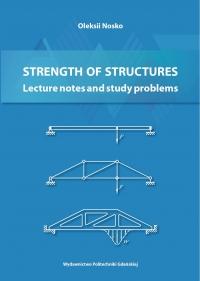
Strength of Structures: Lecture notes and study problems - e-book
ISBN: 978-83-7348-956-1
Numer wydania: 1
Rok wydania: 2026
Język wydania: angielski
Liczba stron: 264
Opis:
Książkę można zakupić w e-sklepie Politechniki Gdańskiej.
The book is available in Gdańsk Tech's bookstore.
Profil naukowy Autora (MOST Wiedzy): Oleksii Nosko
Scientific profile (Bridge of Knowledge): Oleksii Nosko
Słowa kluczowe / Key words: geometry of cross sections, tension, torsion, bending stresses, bending deflections, combined loading, strength theories, energy theorems, force method
This book is a collection of lecture notes and study problems on the subject of Strength of Materials, also known as Mechanics of Materials or Mechanics of Deformable Bodies. It is designed to teach students the most important terms, assumptions, principles and methods of the subject.
The content of the book is organised in the form of ten lectures. Lectures 1–6 are dedicated to the problems of tension, compression, torsion and bending. Lectures 7‒8 deal with the problems of plane stress under combined loading. Lectures 9–10 introduce the energy methods for solving statically determinate and indeterminate problems.
Before taking the course of Strength of Materials, students should have completed a course of Mechanics. In particular, they are expected to know and be able to apply the conditions of static equilibrium and the principles of conservation of energy. Since the solution of study problems requires the application of the methods of differential and integral calculus, students should also have completed a course of Mathematical Analysis.
The focus of the book is to help students develop the skills to efficiently schematise, solve and analyse the typical problems of the subject. The study problems considered are categorised into twenty groups P1–P20, each of which is assigned to a specific lecture. The study problems are formulated both in ‘classical’ form, when the aim is to determine an internal force, displacement, stress or strain in a structure under the action of certain loads, and in ‘engineering’ form, when the aim is to determine the maximum loads or minimum geometric sizes for which the structure retains its load-carrying capacity. The book contains all algorithms and formulae required to solve the study problems. Nonetheless, it should be considered as a basic introduction to the subject. Systematic reading of the comprehensive textbooks, e.g. [1−5], is necessary for a deeper understanding of the subject.
ADDITIONAL MATERIALS
Artificial Intelligence
P1: 1, 2, 3, 4, 5
P2: 1, 2, 3, 4, 5
P3: 1, 2, 3, 4, 5
P4: 1, 2, 3, 4, 5
P5: 1, 2, 3, 4, 5
P6: 1, 2, 3, 4, 5
P7: 1, 2, 3, 4, 5
P8: 1, 2, 3, 4, 5
P9: 1, 2, 3, 4, 5, 6, 7, 8, 9, 10
P10: 1, 2, 3, 4, 5, 6, 7, 8, 9, 10
P11: 1, 2, 3, 4, 5
P12: 1, 2, 3, 4, 5
P13: 1, 2, 3, 4, 5
P14: 1, 2, 3, 4, 5
P15: 1, 2, 3, 4, 5
P16: 1, 2, 3, 4, 5
P17: 1, 2, 3, 4, 5
P18: 1, 2, 3, 4, 5
P19: 1, 2, 3, 4, 5
P20: 1, 2, 3, 4, 5
Finite Element Method (FEM)
P3.4: docx, pdf
P4.3: docx, pdf
P5.5: docx, pdf
P6.5: docx, pdf
P7.4: docx, pdf
P8.3: docx, pdf
P9.10: docx, pdf
P10.10: docx, pdf
P11.5: docx, pdf
P12.4: docx, pdf
P13.4: docx, pdf
P15.5: docx, pdf
P16.5: docx, pdf
P17.5: docx, pdf
P18.5: docx, pdf
P19.5: docx, pdf
P20.5: docx, pdf
Pobierz spis treści (pdf, 642.76 KB)
Zakup publikacji:
| format | cena netto | cena brutto | dostępność |
|---|---|---|---|
| e-book | 56,00 | 58,80 | dostępne |